What does this website cover, and what does it leave to others?
This site deals only with surfaces that vehicles drive or park on: private driveways, the apron in front of a garage door, ramps and sloping drives, shared parking in a community of owners, yards outside industrial units and the long entrance roads of villas and country estates. Anything a car, van or delivery lorry will cross belongs here, from a single parking bay to a large open yard.
Terraces, pool surrounds and garden paths are a different job with different priorities, so they are handled on our terraces and pools site. If an existing drive has sunk in wheel tracks, the question is a repair rather than a new build, and that is explained on the sinking driveway page. Prices are published in one place only, the network's price site, so you will not find figures here.
- Driveway block paving for houses, townhouses and villas.
- Garage entrances, where water, door thresholds and turning tyres meet.
- Sloping driveways and ramps that need grip, restraint and controlled run-off.
- Car parks and communities, including the paperwork that shared areas involve.
- Industrial yards for forklifts, loaders and delivery vehicles.
- Villa and estate entrances, often long, curved and reached by narrow roads.
Why does the type of traffic decide how a driveway is built?
Because block paving is a layered system, and each layer is sized for what will run over it. A drive used by one family car asks far less of the base than a yard where a loaded forklift turns on the spot every few minutes. Getting this match wrong is the usual reason a drive starts rutting, rocking or sinking after a few seasons of use.
When we look at a new job, the first questions are practical. Which vehicles will use it, how often, and do they turn, brake or stand still on the paving? Will a removal lorry, a skip truck or a cement mixer ever need to reach the house? The answers shape the depth of the compacted sub-base, whether a bound layer is worth adding, the block thickness and the bond pattern chosen for the surface.
We deliberately avoid quoting load figures or layer depths on this page. Those numbers depend on the ground, the access and the intended use, and they are settled for each job, not copied from a brochure. The reasoning behind each choice is set out step by step in our guide to the base for different traffic loads, which is a good place to start if you want to understand a quote before you accept it.
Which paving pattern and block shape suit a driveway?
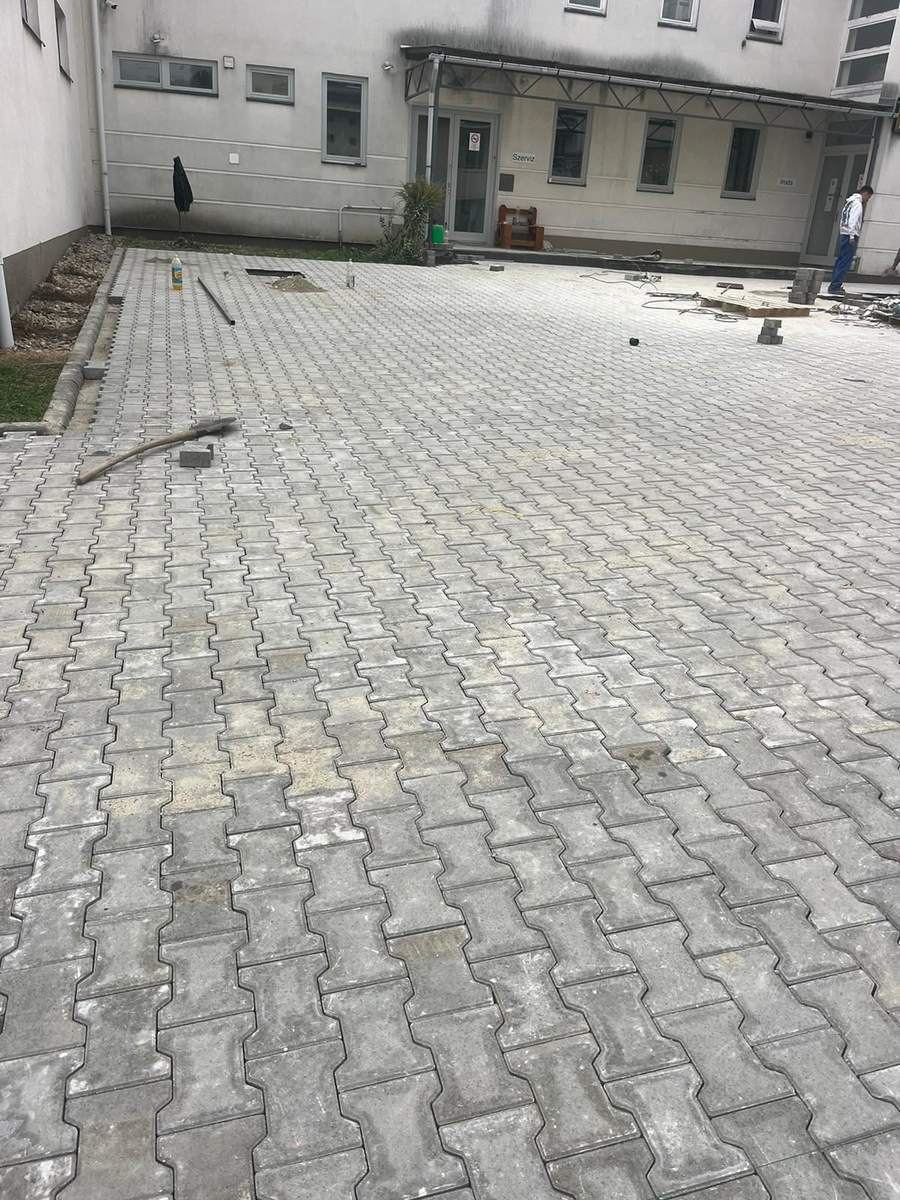
For surfaces that take turning wheels, interlocking patterns perform better than straight rows. Herringbone, laid at 45 or 90 degrees, spreads braking and steering forces across many neighbouring blocks, and shaped blocks such as the double-T lock into each other on every side. Straight stretcher bond looks clean on a narrow path but tends to creep under tyres that turn.
That does not rule out a softer look. Rectangular blocks in blended colours, laid in herringbone, give a residential finish that still holds under daily use, and multi-size formats can work where traffic is light, such as a pedestrian strip beside the parking bays. The comparison between concrete, natural stone, clay and permeable blocks is covered on our sister site under concrete block paving; here we focus on how each behaves under vehicles.
- Double-T and other shaped interlocking blocks: the usual choice for yards, car parks and heavily used communal drives.
- Rectangular blocks in herringbone: a common choice for private drives and villa entrances.
- Mixed-size or straight-laid formats: better kept to footpaths and edges that cars rarely cross.
- Permeable blocks and grass grids: worth discussing where surface water has nowhere else to go.
How do falls and drainage work on a block-paved drive?
Every drive needs a gentle, deliberate fall so that rain runs off the surface towards a channel, a gully or a planted area instead of collecting against the house or the garage door. The fall is built into the sub-base and the laying course, not added at the end, so it has to be planned before any block is laid.
The most delicate points are thresholds, where the drive meets the garage or the front door, and the boundary with the public pavement. A drive that slopes towards the house almost always needs a channel drain across its width just before the threshold. We explain the options, from linear channels to gullies and soakaway areas, in our guide to falls and drains on driveways, and the specific case of the garage door is handled on the garage entrances page.
Joints play a part too. Sand-filled joints let a little water through, which is normal, but a block-paved surface should never be treated as a soakaway unless it has been designed as permeable paving from the ground up. If you already have standing water on an existing drive, the diagnosis belongs to our drainage and standing water service.
Why do edge restraints matter so much on a driveway?
Block paving stays tight only while something stops it from spreading sideways. Kerbs, haunched edging or a solid wall along each side hold the blocks in place, so that the friction between them, and the joint sand, can do their work. Without a firm edge, wheels slowly push the outer rows outwards and the whole surface loosens from the sides in.
On drives that meet a lawn, a gravel bed or a planting strip, the edge is often where a cheap job saves money and an expensive repair begins. We set kerbs or edge courses on a bound bed with a concrete haunch behind them, and we treat the line where the drive meets the street as a structural edge too. The details are explained in our guide to edge restraint on driveways.
Do you need permission from the town hall for a new driveway?
It depends on the town and on what the work includes. In Andalusia, Law 7/2021 (LISTA), article 138.1.a), places minor works of limited constructive scope that do not need a project under a responsible declaration, known as a declaración responsable, and its regulation is Decree 550/2022. Each town hall's ordinance decides which procedure applies to a particular paving job.
Two situations need extra care. If the job touches the public pavement or lowers the kerb to create a vehicle crossing, a vado, separate municipal authorisation is needed under the town hall's own rules. And for Marbella, Estepona, Fuengirola, Benalmádena, Torremolinos, Mijas and the other towns, the procedure for a given outdoor paving job is the one set by the current municipal ordinance, which the town hall confirms. We carry out the works; we do not draft projects or file applications on your behalf.
Our guide to vehicle crossings and permits sets out the questions to ask the town hall before work starts, so that you or your property manager can confirm the route while the quote is being prepared. Owners who live abroad often find it easiest to pass that guide to their gestor or administrator.
How does a community of owners approve paving work on shared areas?
Through a resolution of the owners' meeting. In Spanish communities of owners the Horizontal Property Law (Ley 49/1960) applies, and work on common elements such as a shared drive, a garage ramp or the visitors' car park needs a vote under the majority rules of article 17. Which majority a given job needs is something the community administrator confirms.
We prepare quotes that an administrator can circulate before the meeting: what will be lifted, what will be built, how access to parking spaces will be kept during the works and how waste will be removed. That makes the decision easier for owners who cannot attend in person. The full process, from first photos to the vote and the start date, is covered in our guide for communities of owners, and the most frequent points of friction are described in our article on what tends to go wrong in community paving.
What happens to the old surface and the rubble?
It is removed and taken to an authorised destination. Construction and demolition waste is governed by Royal Decree 105/2008 and Law 7/2022 on waste and contaminated soils, and Law 7/2022 treats rubble from minor domestic building and repair works as household waste under municipal responsibility, so the route depends partly on the size and nature of the job.
When an old drive is broken out, the material usually falls under familiar European List of Waste codes: 17 01 01 for concrete, 17 01 07 for mixtures of concrete, bricks, tiles and ceramics without hazardous substances, and 17 05 04 for soil and stones other than 17 05 03. Waste removal is shown as its own line in the quote, so you can see exactly what is included and compare like with like. For larger replacements, the process is described on our paving replacement page.
How much does a block-paved driveway cost?
The cost is driven by a handful of factors rather than a single rate: the square metres, how easily machinery and deliveries can reach the site, the state of the existing ground, the slope, the chosen blocks, the length of kerbs and the volume of waste to remove. A short drive with awkward access can cost more per square metre than a large, open yard.
All published prices for the network sit on our price site. You can read the block paving cost per square metre, try the online calculator for a rounded range, or look at what a quote includes. For a breakdown of the separate lines in a driveway budget, our article on the items in a block-paved driveway quote explains each one in plain terms.
How does the work run when the drive is in daily use?
With planning agreed before the first block is lifted. Most drives are the only way in and out of a house, a garage or a business, so we agree in advance where cars will be parked during the works, where materials will be stored and when deliveries will arrive. In communities, we phase the job so that some parking spaces stay usable while others are rebuilt.
- You send photos and the approximate square metres; we ask about vehicles, access and drainage.
- We visit if needed, confirm the layout, the levels and the edges, and prepare a written quote.
- We agree access, parking arrangements and, for communities, the timing with the administrator.
- The old surface is removed, the ground is prepared and the sub-base is laid and compacted in layers.
- Edges are set, the laying course is screeded, the blocks are laid, cut, compacted and jointed.
- We send photo updates throughout, which owners who are abroad tend to find useful.
How we organise this on a busy drive is described from experience in our article on running a job on a driveway in daily use. Health and safety on site follows Royal Decree 1627/1997, which sets the minimum provisions for construction works with or without a project.
Who is behind Entradas de Vehículos Málaga?
The site is run by Bauman Raymond Attila, an autónomo based in Marbella who carries out paving works across the whole province of Málaga. To be transparent, the same autónomo also runs the five sister websites in this network, each of which covers one kind of job in detail: materials and replacement, sunken paver repair, terraces and pools, restoration without replacement, and prices.
Splitting the subjects this way keeps each site focused, so a reader looking for a garage ramp is not sent through pages about pool surrounds. We work with Mapei products, and the concrete blocks for each job are chosen to suit its traffic. Concrete paving blocks are covered by UNE-EN 1338 with the Spanish complement UNE 127338, and concrete kerbs by UNE-EN 1340 with UNE 127340.
We work in English with owners who live abroad or spend part of the year on the Costa del Sol, and in Spanish with local owners, administrators and businesses. Send us a photo and the approximate m² – free, no-obligation quote.
How do you keep a new driveway in good condition?
With light, regular care rather than heavy intervention. Sweep the surface, top up joint sand where it has been washed or brushed out, deal with oil drips before they soak in and keep channel drains clear of leaves and grit. Weeds in joints are easier to remove while they are small, and a gentle wash is usually better than an aggressive one that strips the joints.
If the colour fades or the surface looks tired after years of use, it can often be cleaned and refreshed rather than replaced, which is the speciality of our driveway restoration service. For routine care, our driveway maintenance guide lists what to check each season and which signs mean it is time to call someone in.